
The Field That Wasn’t What I Expected
A WhatsApp Message, A Spade, and a Saturday I Hadn’t Planned to Keep
There is a particular kind of Saturday that belongs to nothing in particular — the kind you protect fiercely and accomplish nothing with, on principle. I had one of those scheduled.
Then a message landed in the YFS group.
The Bangalore Development Authority, it said, was organising something called a Mega Plantation Drive. Volunteers needed. Reporting time: absurdly early.
I read the message twice. A week later, I was standing at a metro station before 7 AM with five other people from the team, none of us entirely awake.
Six of us, split neatly into two — three bound for Banashankari, three of us for Nadaprabhu Kempegowda Layout. I drew Zone 5.
The Field
I had pictured something modest. A patch of ground, perhaps. A few dozen people with shovels and a vague sense of occasion.
What I found instead would not stay still long enough to be called modest. Roads dressed in banners for an event most of the city would never personally attend.
Security checkpoints where, on a normal Saturday, there would simply be a footpath. Ambulances parked with the specific patience of things hoping not to be needed.
The drive, I’d later learn, was timed to land on Nadaprabhu Kempegowda Jayanti — the founder’s own birthday, repurposed as the day Bengaluru tried, in one twelve-hour stretch, to put back some of the green it had spent decades quietly losing.
Fifteen lakh saplings, across roughly two hundred and forty acres, with a Guinness World Record dangling at the far end of the morning like a thing nobody wanted to mention out loud in case it jinxed it. Indore had set the previous mark, at twelve lakh. Everyone, without quite saying so, was doing the arithmetic.
I had arrived expecting a drive. I had walked into an operation.
What the Work Actually Asks
Nobody handed me a manual. Someone handed me a sapling, still wrapped in its plastic sleeve, and pointed at a hole someone else had already dug.
That, it turned out, was the whole instruction set. You found your place in a line that nobody had formally organised and that functioned anyway — one person breaking the dry soil, another setting the sapling in with both hands like it might bruise, a third stripping away the plastic, someone always circling back with water before the roots could notice they were thirsty.
I dug for a while. I planted for longer. By midday I had stopped keeping track of which job was mine, because the line didn’t seem to care, and neither, eventually, did I.
The Mosaic in the Mud
What struck me, more than the scale of it, was who else was there.
Schoolchildren who had, by all visible evidence, decided this was a competition, and were winning it — ten saplings, twelve, more, while the rest of us were still negotiating with our backs.
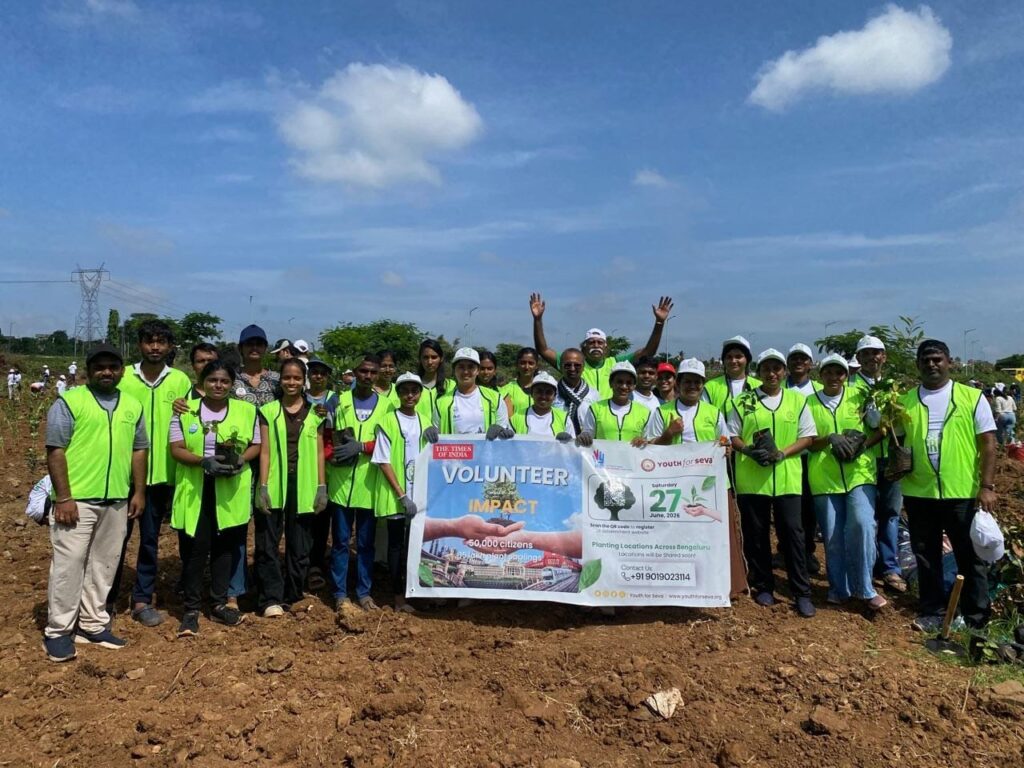
BBMP workers next to corporate employees on their CSR day next to someone’s grandparent who had simply shown up with his own pair of gloves, because apparently that’s a thing some people keep at home.
I spoke to a few faces I half-recognised from television, who said, almost apologetically, that they weren’t here to be photographed, just to plant something and leave quietly. I believed them, mostly because nobody was paying them any particular attention — everyone was far too occupied with their own patch of ground to notice who was kneeling in the next one.
Even our quietest volunteer, the one who generally communicates in single-word replies, was laughing with a stranger about whose row of saplings was straighter. There did not seem to be an age at which you were either too young or too old for this. There was only whether you’d shown up.
What the Land Looked Like by Evening
By morning’s end, our patch had been a flat, dry, faintly disappointing stretch of brown. Nobody would have looked twice at it.
By late afternoon it was something else — rows of young, stubborn green standing where there had been nothing, and a breeze moving through it that had, I am fairly certain, not existed six hours earlier. I may have imagined that part. I choose not to think so.
What I noticed, more than the trees themselves, was the particular look on everyone’s face by the time we were packing up — tired in the ordinary way, but also lit faintly from somewhere underneath, the way people look when they’ve made something that existed that wasn’t there that morning. I didn’t plant enough saplings to matter to a Guinness adjudicator. I planted exactly enough to matter to me.
I went home and, true to form, wrote about this instead of resting. It might be the closest thing I have to a green thumb.
The world record, if it comes, will belong to somebody’s spreadsheet. The sapling is mine to look after now.
Saarika G / Communications Team
Volunteer / Bengaluru
Good one sarika.
sadly i wasnt a part of this move but by the wat its described here by the writer of this blog saarika,almost felt like i experienced the whole thing as if i planted those saplings,very beautifully written and an awesome move by the organisation and people