Words have meaning and names have Power!
Imagine yourself in the shoes of a tribal villager who has beaten many odds since childhood to emerge as a young Post Graduate in Commerce with an opportunity to join the elite Indian Air Force.
But you see that your village has no proper roads hence lacks accessibility, it is barren through most parts of the year hence agriculture is hard to pursue and there is highly rampant migration of fellow villagers to cities in search of livelihood.
It is very likely that 9/10 of us would put self ahead of our village and even our own villagers may not see that as a selfish thing to do.
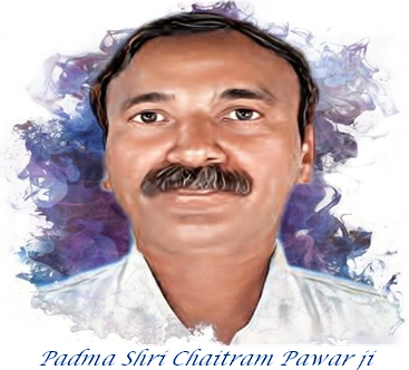
But not if you are Chaitram Devchand Pawar.
You stay back at your village with a firm belief that “ग ांव के लियेकु छ करन हेतो ग ांव में रुखन पड़ेग ”. Sometimes even the person themselves may not know that they are put on this earth for a specific purpose, to make a difference for their fellow human beings. And many a time their name itself provides a hint towards what that individual will accomplish in future.
In Sanskrit, Chaitra (चैत्र) primarily means the first month of the Hindu lunar calendar, which aligns with the spring season. The name is a synonym for freshness (light green leaves & buds), brightness (signalling the onset of summer), vibrant welcoming of a new spring (Vasanta) which sees festivities like the Hindu New Year Yugaadi / Gudi Padwa and colourful Holi.
Baripada, is a tribal village in Dhule district of Maharashtra, 400 kms from Mumbai the capital city, but much closer to the border of Gujarat. A double degree commerce graduate, Chaitram Pawar ji, observed that in the early 90s the village was losing forest cover rapidly due to illegal felling of trees and because of its proximity to the hot deccan plateau, the ground water was drying up long before summer and hence with agriculture also not a viable option many of the youth from the villages had begun migrating to the cities in search of their livelihood.
At the crossroads in his own life, with a job offer on hand, while he could have also chosen the easier wayout, Chaitram Pawar ji instead chose to stay back and ask himself the question;
क्य एक ग ांव खुद अपनी खोयीहुई प्रकृ लत और खुश िी व पस ि सकतीहै?
A survey of the villages done in the 90s indicated that non-existent approachable roads and depleting ground water levels leading to the failure of agriculture were the primary reasons why there was large scale migration of villagers.
Wanting to address the problem but having no proper direction or guidance to do the same, Chaitram Pawar ji took the initiative and with the help from some of the villagers planted about 5,000 saplings in and around the village but did not know what had to be done next.
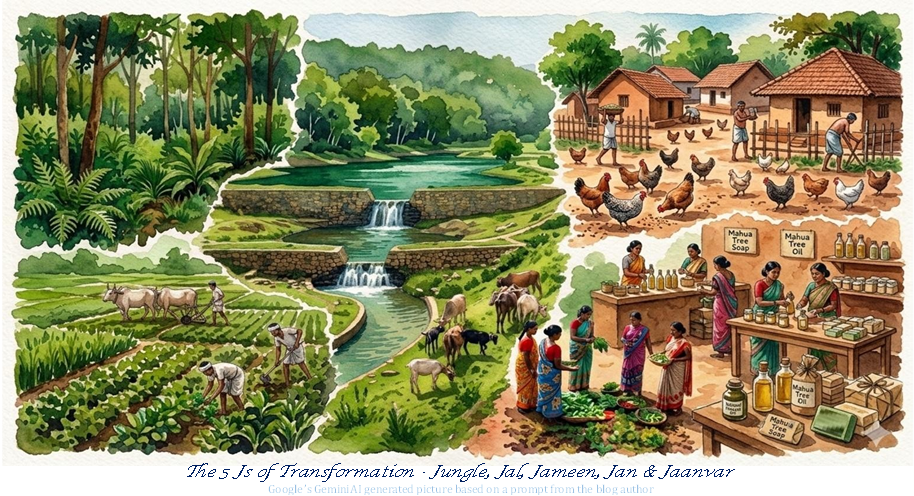
A chance meeting with Dr. Anand Pathak from the Vanavasi Kalyan Ashram ensured the much-needed guidance and direction for Chaitram Pawar ji and the villagers’ efforts towards addressing their problems. They broke-down their problems into a 5-stage approach and prioritized them in order of their urgency to be resolved. These were unofficially referred to as the 5 Js
Jangal, Jal, Jameen, Jan and Janwar.
It was not all smooth sailing though, far from it. There were hurdles at every step of the way, but their resilience helped them tackle each of the problems as they occurred.
They drafted rules to guard the forest trees and created a Forest Protection Committee (FPC) through which a round-robin method of electing guards from each household to keep watch on the forests was rostered and they also introduced penalties when rules were broken.
Lack of sufficient firewood for cooking saw the village ladies oppose the move strongly. So, they explored getting LPG cylinders and tried solar cooking as well. When neither of these were found viable in the long term, they finally settled on the Smokeless Chula (Stove) for cooking.
To address the water issue they built nearly 700 check-dams and 40 reservoirs which were funded from श्रमदन (public pooling of required funds) instead of waiting for or seeking funds from the government.
Slowly these initiatives resulted in increased ground water levels which the villagers noticed and worked with Krishi Vigyan initiatives and explored growing multiple crops across the year. Over time the migration of youth to cities also saw a declining trend. Self-help groups emerged to engage the villagers in organic farming as well as the production of oil and soaps from the Mahua Trees whose value went up to 1 lakh rupees per tree.
Seeing the success in bringing sustainable development in Baripada village, other villages started joining the transformation journey and in no time 35 villages were working as a cluster adopting these sustainable practices.
The locally grown vegetables and products were gradually linked with the markets to generate revenue for the villagers. 112 farmers from over 45 villages guided by Krishi Vigyan initiatives grew the famous local brand of Indrani Chawal (rice) and marketed through sources for consumption across the state and country.
Several institutions like the Azim Hasham Premji University and individuals representing international bodies came to study the Baripada transformation story and two PhDs were completed on this world-renowned model. These studies estimated that the value of the forest alone was a whopping 3,000 Crores. 435 species of trees were documented post the afforestation drive. A Van Sabzi Pratiyogita (forest vegetable-growing competition) was organized where 110 vegetables were registered as being grown in 2005 across 60 villages and the same went up to 250 vegetables in a span of two decades showcasing the progress made in botanical sustainability.
In 2014 a United Nations Development Program team came visiting to seek evidence of the transformation famously known around the world as the “Bari Model”. The UNDP representatives on first glance were shocked to see a village full of thatched hut roofs and domesticated animals with only four people in the entire village registered as bank account holders
This is where people like Chaitram Pawar ji, who are referred to as those educated in & by their thoughts, सोच से पढ़ेलिखे, have a totally different definition of Sustainable Development. The villagers explained to the UNDP team that:
A very popular West-African proverb says “It takes a village to raise a child”. But if that child were to be even 10% as focused and committed as Padma Shri Chaitram Pawar ji, then that village and its residents will surely reap benefits 100 times more than its own expectations!
Mahatma Gandhi famously said that “The soul of India, lives in its villages “.
These 35 self-reliant villages achieve long-term sustainability through complete agricultural self-sufficiency on 5 acres of fertile land per village, zero reliance on fossil fuels by using traditional oxen transport, and localized revenue generation through organic rice, Mahua oil, and Mahua soaps. Governance and ongoing development are driven by quarterly youth-led meetings with representatives from each village to address local challenges and plan long-term eco-friendly solutions.
And as Chaitram Pawar ji himself articulated, looking back over the past 3 decades and seeing what they had accomplished, they could confidently say that they have united their village folks, 435 hectares of forestation had been achieved, through self-funding, 700 check dams were built and 35 wells were dug which gave them access to water all through the year (no borewells drilled), 5 villages were now free of water tanker dependency and more were joining this list year after year.
So that is Baripada’s sustainable development story
Amused by how much the villages had managed to achieve by themselves despite lack of any structured government or financial help, one of the UNDP representatives asked them how would they undertake future projects as they had nearly zero working capital.
A smart youth from one of the villages was quick to respond to them stating that each house in their village was an ATM by itself from where the working capital comes.
Smiling at the young man’s perceived childish response the representative asked him to elaborate and to the astonishment of many villagers themselves the boy pointed to the local breed of well-fed hens roaming all around the village and explained that these desi murgi are highly sought after and each is priced at 500₹ and easily, each village had about 4,000 such poultry which potentially translated to a working capital of 15 lakh rupees (1.5 M ₹).
While the Baripada village has been the recipient of many local and international awards including it being recognized as the 2nd best out of a 78-country global village study by the International Fund for Agricultural Development (IFAD), Chaitram Pawar ji explains that funnily enough rewards are also a problem as every villager wants to seek a part of the credit.
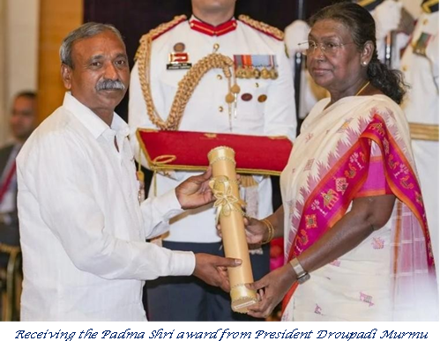
Hence in April 2025, when the Republic of India conferred on him the 4th highest Civilian Award, he had arranged for 35 of his fellow villagers to accompany him to Delhi for the ceremony. And on the way back home they had booked flights to Surat to make the trip even more memorable for the villagers.
However some of the ladies who were virtually unaware of the ways and means of how flying in an aircraft works, entered the aircraft and put their bags on first available empty seats and sat down and when their designated occupants came and requested them to vacate the seats the village ladies promptly asked them
to find other vacant seats as these had already been taken!
Even this was seen as an opportunity by Chaitram Pawar ji when he says that until the last person in the village is educated, we will continue our initiatives and we need the youth of this country to help take us further forward in the direction of inclusive progress when it comes to use of technology.
He went on to add “My idea of village swaraj is that it is a complete republic, independent of its neighbours for its own vital wants, and yet interdependent for many others in which dependence is a necessity.”
So, when a village thrives its energy reverberates and whole of India will begin to thrive. Hence Chaitram Pawar ji’s Baripada is an ideal village that encapsulates the dream our Father of the Nation had about them being self-reliant.
Youth For Seva was honoured to have this distinguished Padma Awardee as one of the esteemed panelists at Padma Samvaad, organised at IIT Delhi. Chaitram Devchand Pawar’s remarkable journey of service and contribution to society added immense value to this meaningful conversation on grassroots transformation and social impact.
Nagesh Mallikarjun
Volunteer, Bengaluru.
nageshm28@hotmail.com